



In 1950, on a visit to Darjeeling, Sangharakshita found himself being drawn into the Tamang Gompa in the heart of the Darjeeling bazaar. It was here that he had his first encounter with the Greatly Precious Guru, Padmasambhava. This is how he describes it in his memoir, Facing Mount Kanchenjunga —
“I had never seen an image of Padmasambhava before, perhaps not even a painting. As I entered the temple, all the greater was the shock, therefore, when I saw in front of me, three or four times larger than life, the mighty sedent figure of the semi-legendary founder and inspirer of the Nyingmapa tradition, a skull cup in his left hand, a staff topped with skulls in the crook of his left arm, and the celebrated ‘wrathful smile’ on his moustached face. All this I took in instantly, together with the ‘lotus hat’, the richly embroidered robes, and the much smaller flanking figures of his two consorts, one Tibetan and one Nepalese.
“Having taken it in, I felt that it had always been there, and that in seeing the figure of Padmasambhava I had become conscious of a spiritual presence that had in fact been with me all the time. Though I had never seen the figure of Padmasambhava before, it was familiar to me in a way that no other figure on earth was familiar: familiar and fascinating. It was familiar as my own self, yet at the same time infinitely mysterious, infinitely wonderful, and infinitely inspiring. Familiar, mysterious, wonderful, and inspiring it was to remain. Indeed, from then on the figure of the Precious Guru, — Guru Rimpoche, — was to occupy a permanent place in my inner spiritual world, even as it played a prominent part in the spiritual life and imagination of the entire Himalayan region.”
Sangharakshita, Facing Mount Kanchenjunga (CW21, p. 93)
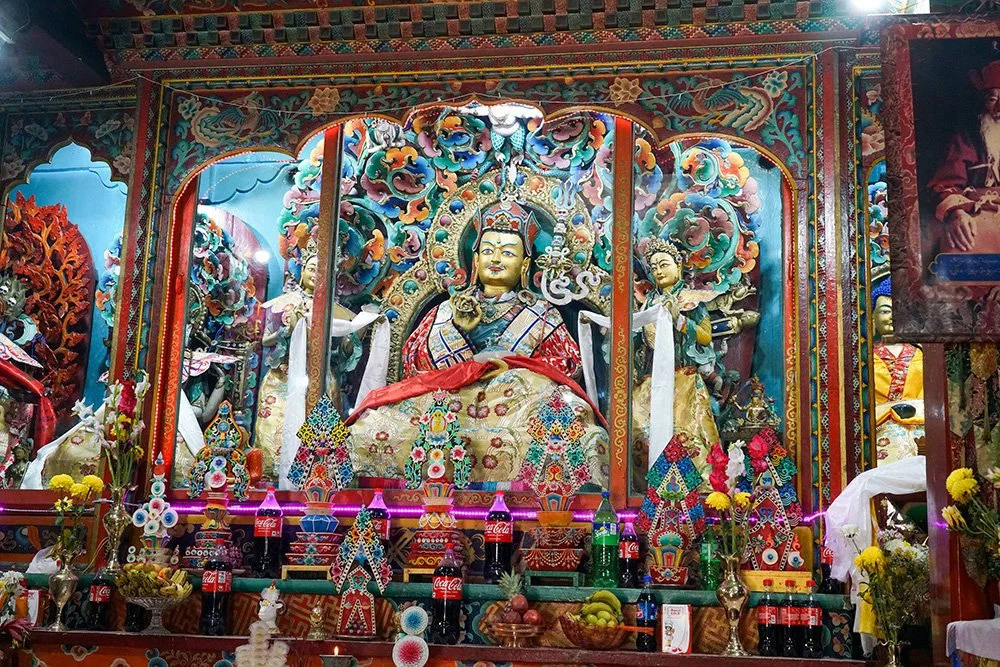
What is striking about Sangharakshita’s first meeting with Padmasambhava is that it was an encounter with an image. And it was a direct encounter — completely unmediated by words and concepts. The image of the Greatly Precious Guru spoke to him directly, making him aware of something deeply familiar, but which remained a mysterious, wonderful and inspiring presence throughout his whole life. We can perhaps wonder what ‘subtle alchemies’ were set in motion in Sangharakshita by that first meeting with the Guru — what transformations took place within him.
This exhibition traces the expressions and manifestations of Padmasambhava in Sangharakshita’s life. Through images, sacred objects, sound recordings, and old manuscripts discovered in the Sangharakshita Archive, we hope to show how important Padmasambhava was to Sangharakshita and how important Sangharakshita’s bond with Padmasambhava has been for the Triratna Buddhist Order and Movement. Of course it can never be reduced to a final definition. Sangharakshita describes Padmasambhava’s presence as ‘mysterious’ and ‘wonderful’ and we want to evoke that mystery and wonder. And the story of Sangharakshita’s meeting with Padmasambhava is not over – it never will be, because we, and those who come after us, are part of the story, a story that will continue, taking on new forms and new manifestations. In the words of Padmasambhava himself—
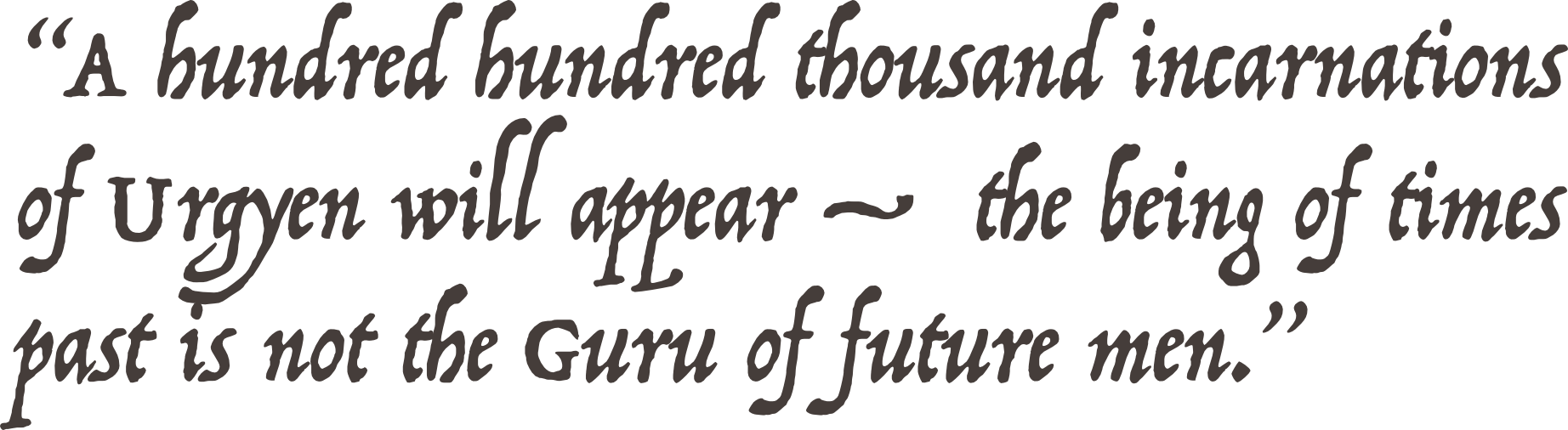
The Life and Liberation of Padmasambhava, Canto 93
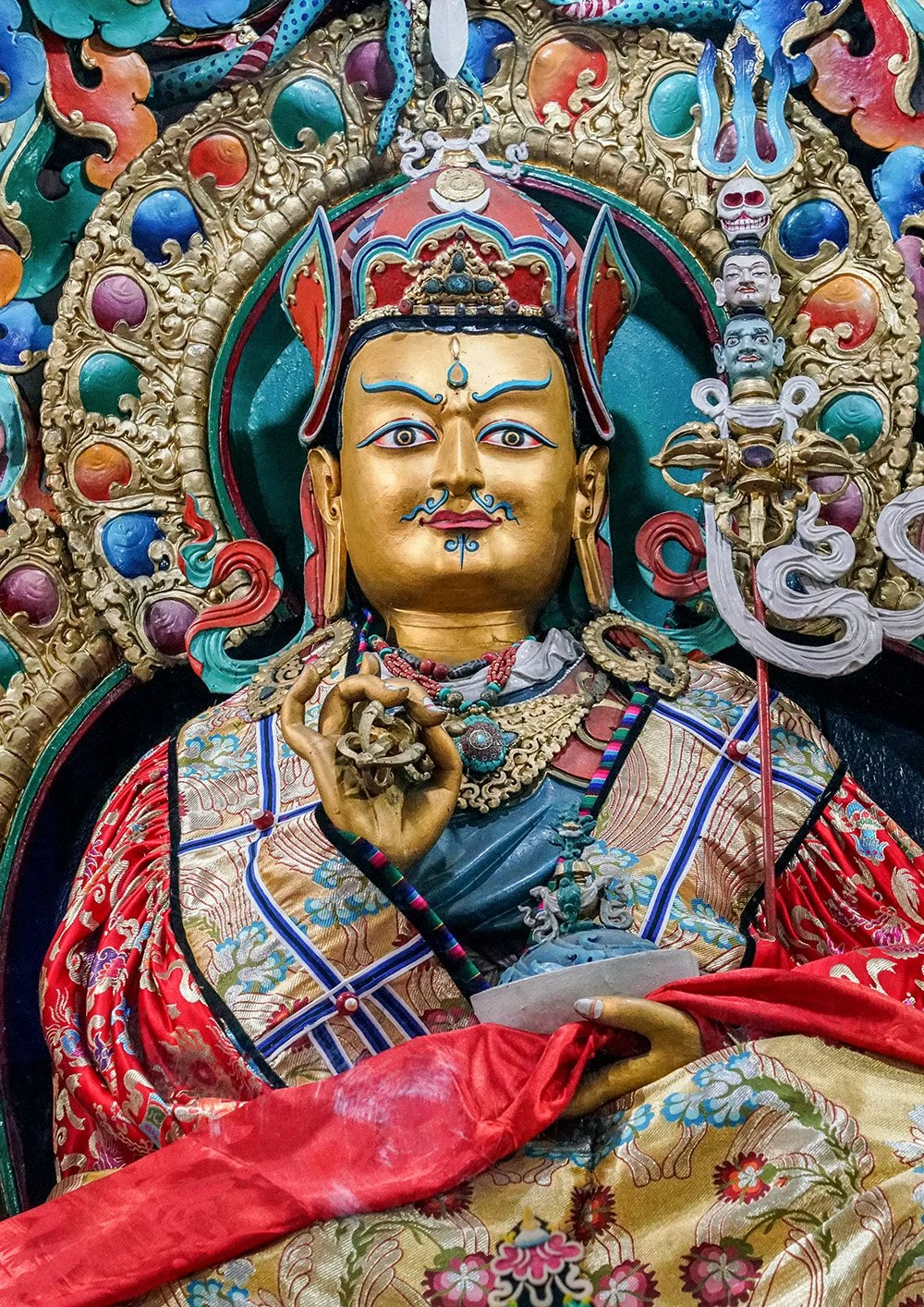
Photograph ©️ Mahaprasara, Sheffield
Padmasambhava rūpa
The main shrine figure in the Tamang Gompa, Darjeeling, India.