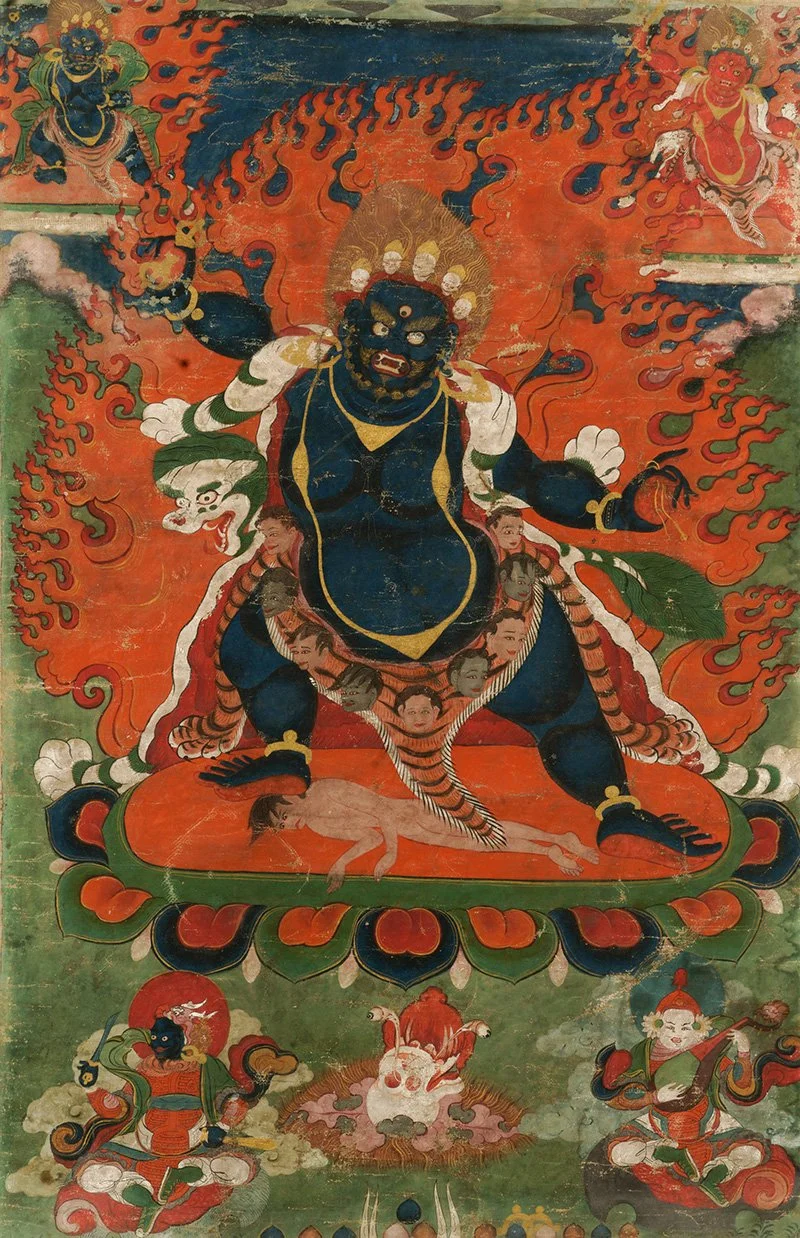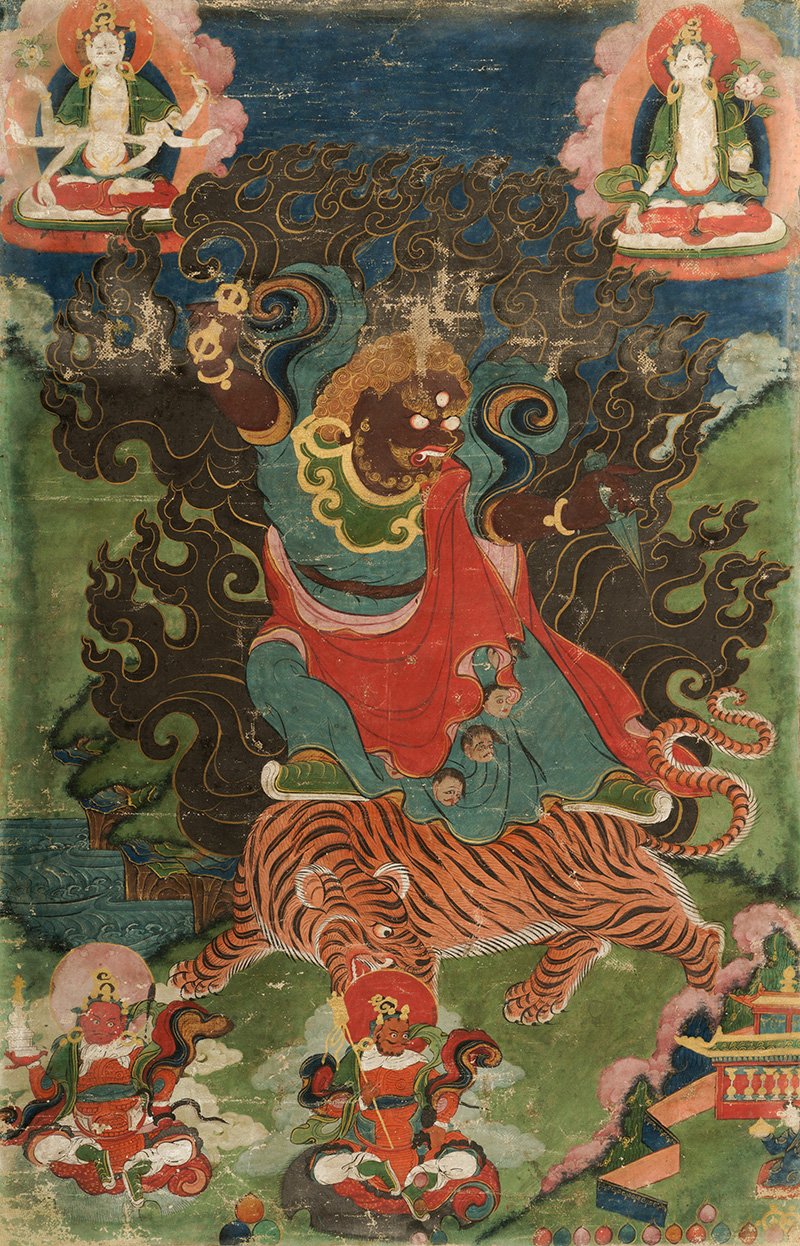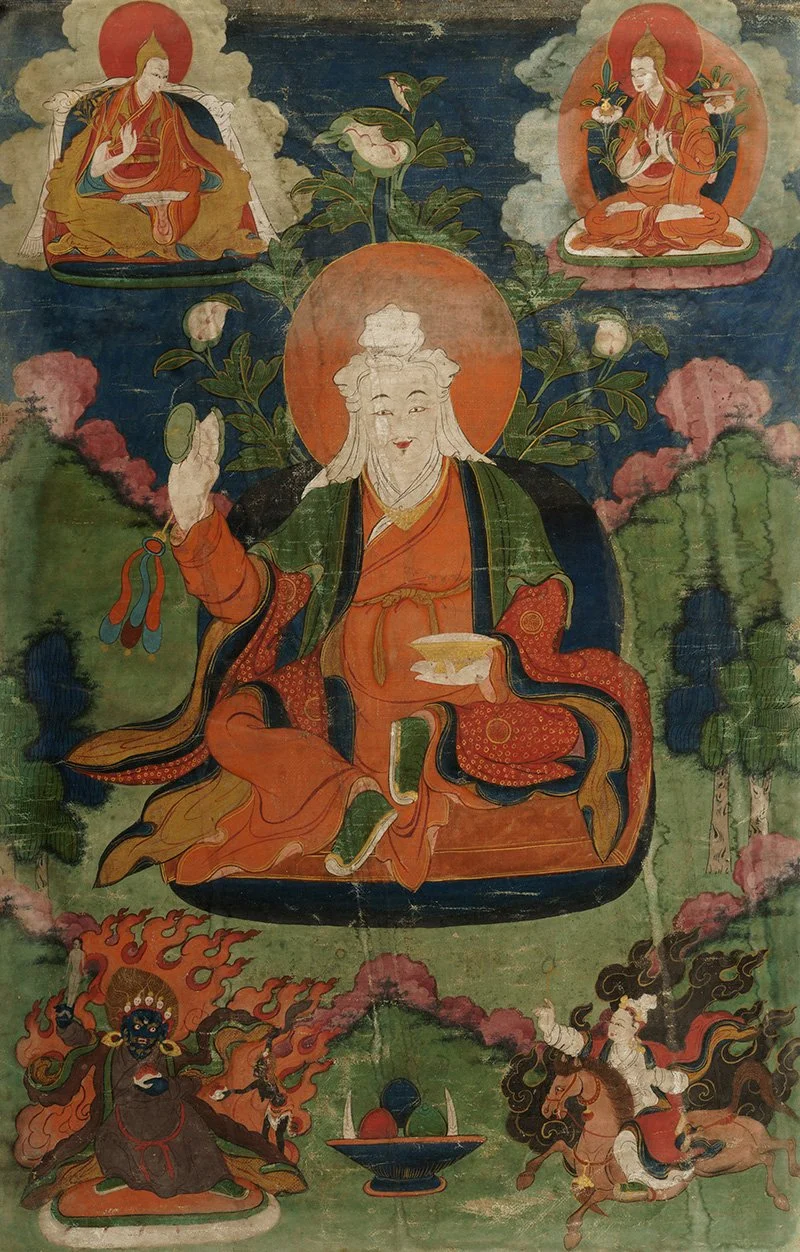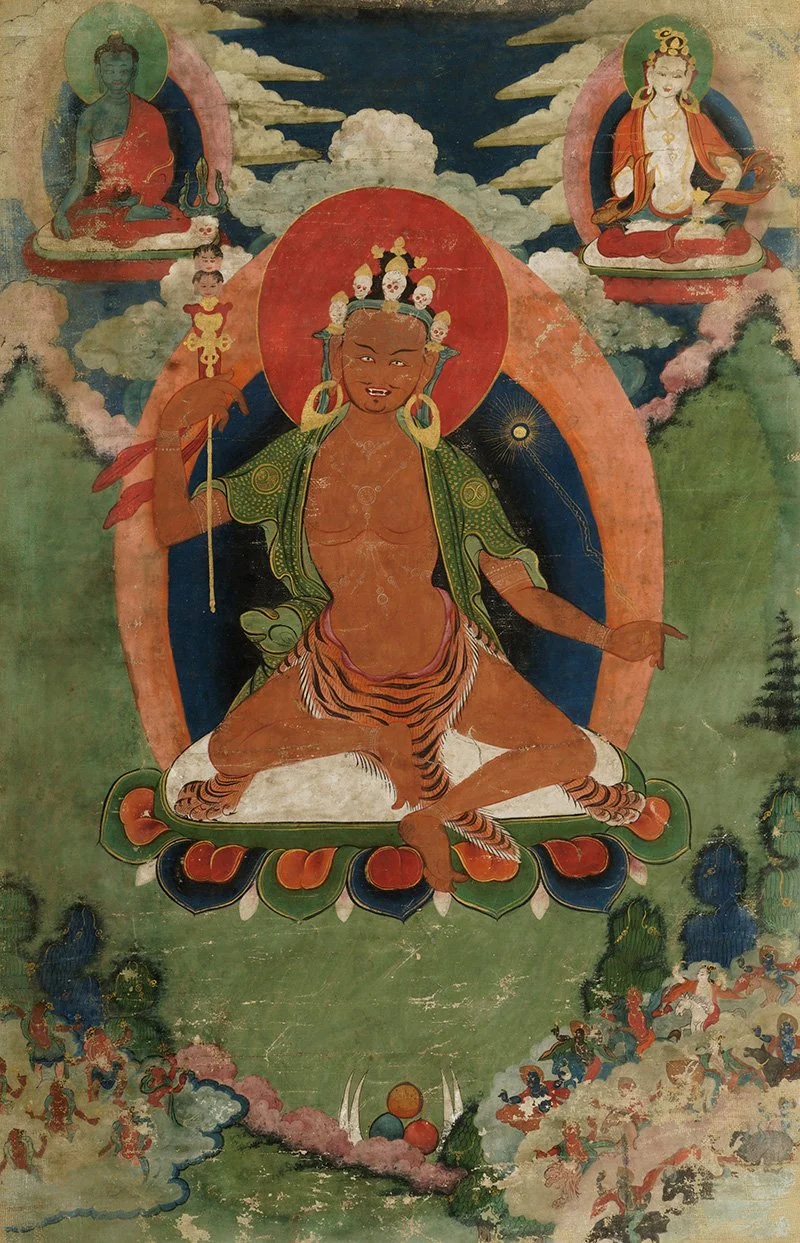



Around the time that Sangharakshita received his initiation into the Padmasambhava visualization practice and discovered the Tharpe Delam, there occurred another event which took him still more deeply into the mystery of the Precious Guru. Once again, this arose through an encounter with an image, or rather, images —
“My coming across the Nyingma woodblock prints so soon after receiving the Padmasambhava abhiṣeka may be regarded as an example of what Jung called synchronicity, or ‘the simultaneous occurrence of events which appear significantly related but have no discernible connection’. But as though one was not enough, there occurred around the time of my initiation another example of the phenomenon. One morning, a poorly clad Tibetan, evidently a refugee, came to the Vihara carrying a set of thangkas he wanted me to buy or, as he would have said, ‘ransom’, for things sacred were not to be bought and sold like so much merchandise. So far as I remember, he wanted a hundred rupees for the set. As gently as I could, I explained that I was not in a position to buy any thangkas just then, but the only result was that he lowered his price, thinking I was bargaining. This went on for some time, with me continuing to plead poverty and the wretched Tibetan again and again lowering his price. Eventually he reached a rock-bottom forty rupees. As it happened, forty rupees was all the ready money I had in the world at the time, but as the man was obviously desperate for money I bought the thangkas, feeling ashamed that I was getting them for so little and wishing I could have given more.
“There were eight thangkas in the set, and on unrolling them I found that they depicted the eight manifestations of the Precious Guru, one of them being none other than Shakya Senge, the historical Buddha, who according to the Nyingma tradition was the teacher of the sutras, whereas Padmasambhava had taught the tantras. Though I knew very little about thangkas, I could tell from the style that they were old, probably eighteenth century or earlier. They were mounted in tattered brown silk brocade, which in some places hung in strips. After inspecting them carefully, I hung them on the walls of my study-bedroom, five on one wall and three on the other, where they remained for the rest of my time in India.”
Sangharakshita, Precious Teachers (CW22, pp. 475-476)
These eight forms of Padmasambhava reveal something of crucial importance to an understanding of the Precious Guru — something that Sangharakshita understood very well. In explaining their significance to a gathering of Order members, he said that Padmasambhava is essentially “the Yidam because he gives the Dharma in a specific way to each individual. He adapts the Dharma to each individual. He has eight (and many more) forms.”
And on another occasion, he said this about the eight forms of Padmasambhava —
“Before going to Tibet, Padmasambhava visited many parts of India and the adjacent regions, and, according to legend, in each of the regions he visited, he assumed a particular form suited to the inclinations and temperament and spiritual needs of the people of that particular region. He assumed very many forms but, later, eight forms in particular were recognized, and these eight forms of Padmasambhava are commonly depicted in Tibetan thangkas.”
Sangharakshita, In the Realm of the Lotus (CW26, pp. 234-236)
-
![]()
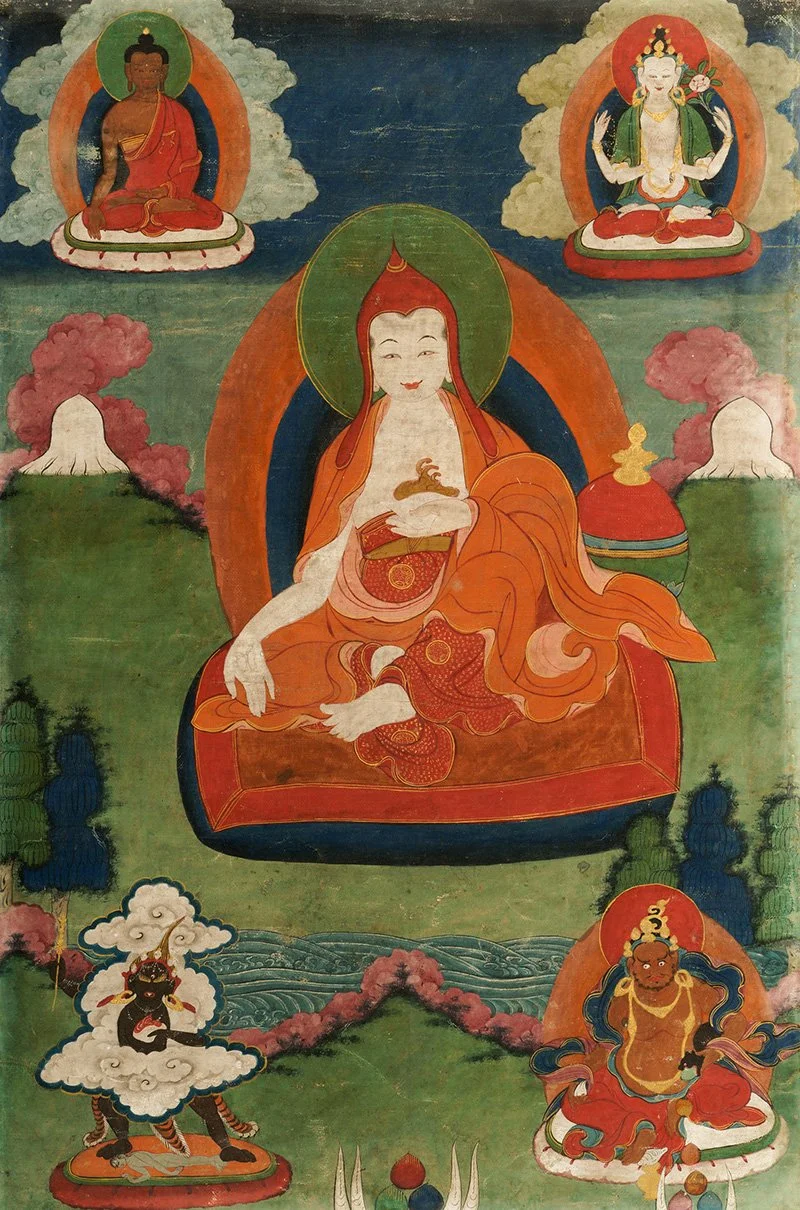
Guru Padmasambhava — ‘Lotus-born’
“The form known as Guru Padmasambhava is the one in which Padmasambhava went to Tibet. Here he is found in the robes of a Buddhist monk, and wearing the so-called ‘pandit cap’, signifying a master of the Buddhist scriptures. Thangkas conventionally depict snow peaks in the background, which probably represent the snows of Tibet to which he journeyed.”
-
![]()
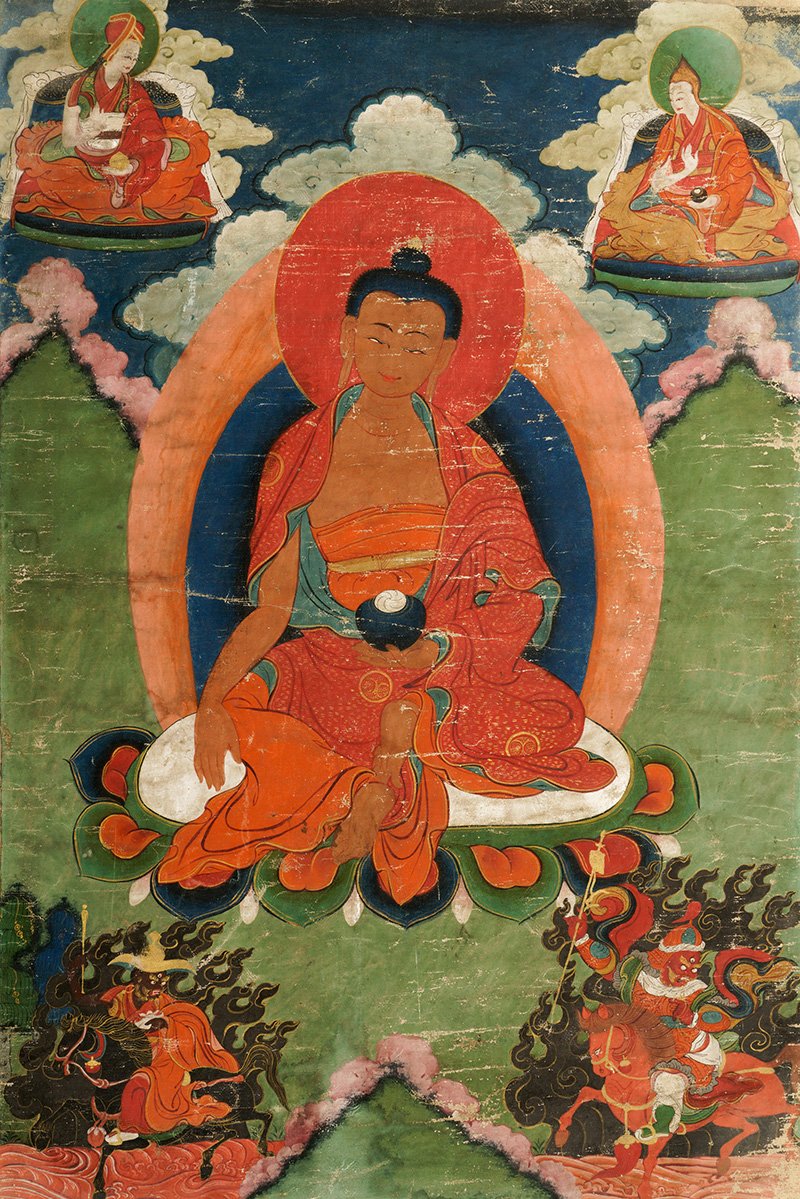
Guru Shakya Senge — ‘Lion of the Shakyans’
“The Shakyasingha form of Padmasambhava represents him as the ‘lion of the Shakyans’, which is, of course, the title of the Buddha himself, Shakyamuni — the historical Buddha. The followers of Padmasambhava, the Nyingma sect of Tibetan Buddhism, go so far as to say that the Buddha Shakyamuni was one of the eight forms of Padmasambhava — a view which most Buddhists would not, of course, accept.”
-
![]()
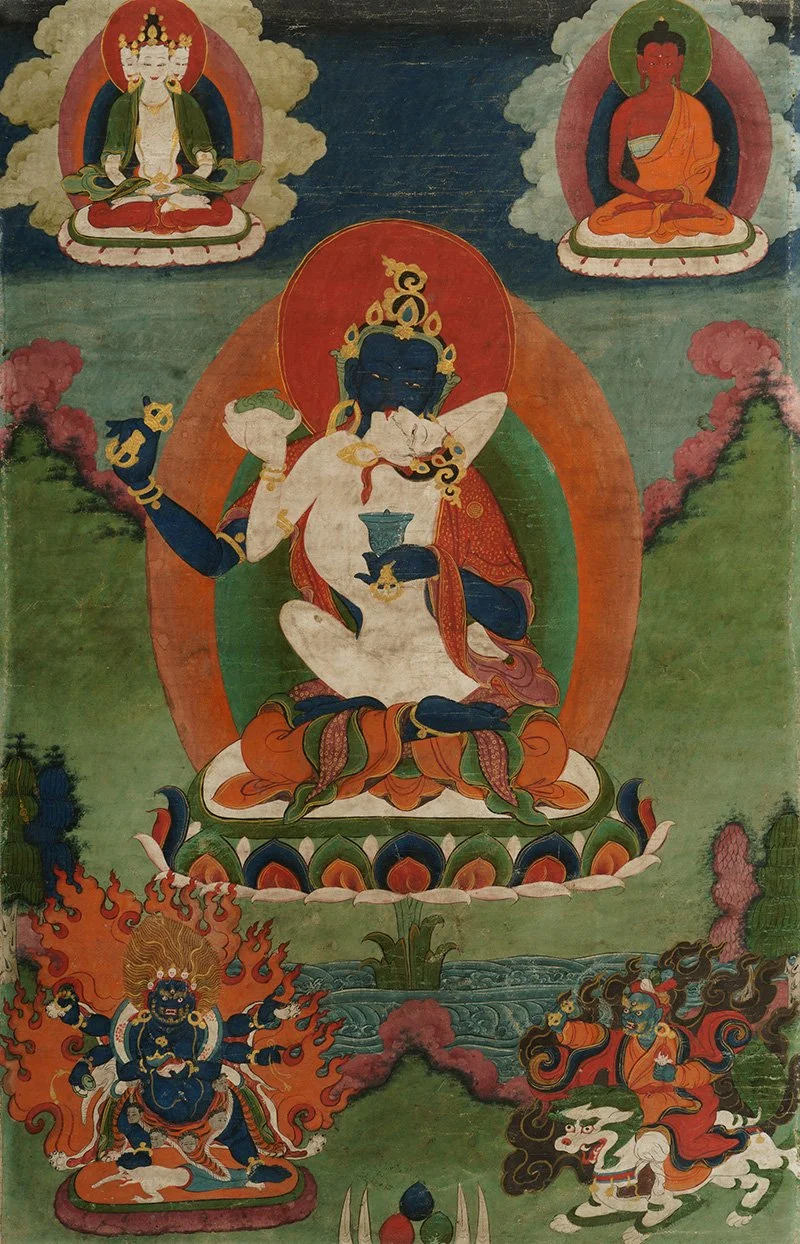
Guru Urgyen Dorje Chang — ‘Vajra Holder from the land of Uddiyana’
“The esoteric form of Padmasambhava comprises a male Buddha form and a female Buddha form locked in embrace. The male Buddha form represents compassion and the female Buddha form represents wisdom, so the figure as a whole represents the union, so to speak, of compassion and wisdom within the Enlightened mind of Padmasambhava.”
-
![]()
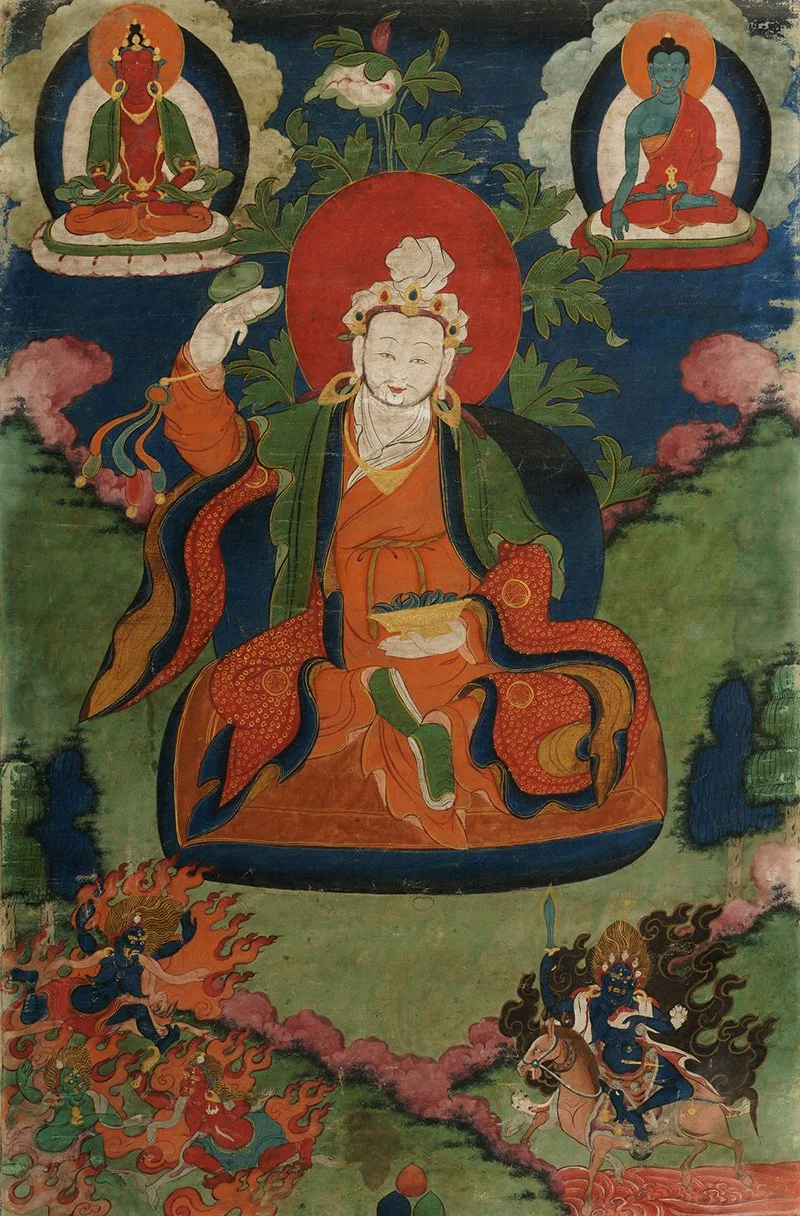
Guru Loden Choksed — ‘Thoughtful Coveter of the Best’ or ‘Intelligent Seeker of Supreme Knowledge’
“Next, the form of Padmasambhava known in Tibetan as ‘the thoughtful coveter of the best’ depicts him as a lay teacher. He's carrying a damaru, a little Tibetan drum, which represents the sound of the Buddha’s teaching; and he also bears a bowl full of nectar to represent the blissful experience that results from practising that teaching.”
-
![]()
Guru Dorje Drolo — ‘Adamantine Sagging-Belly’
“There are two wrathful, demonic forms that Padmasambhava assumes. In one he is riding on a tiger and wielding the diamond or thunderbolt sceptre in order to counteract the negative influence of false teachers.”
-
![]()
Guru Simhanada — ‘The Roaring Lion’
“The other is called ‘the Roaring Lion’, in which form he again subdues the forces of evil.”
-
![]()
Guru Padma Gyalpo — ‘Lotus King’
“Then there is Padmasambhava as the ‘Lotus King’. In this form he is sounding a damaru and he has a bowl with what in some depictions is shown as a moon. Here he represents a righteous ruler — that is to say, a king who rules his country in accordance with the principles of the Dharma, the Buddha’s teaching.”
-
![]()
Guru Nyima Odzer — ‘Rays of the Sun’
“Finally, Padmasambhava appears as a yogi. He wears just a tiger skin round the waist, and a very meagre upper garment, and he carries his characteristic staff, with the five skulls to represent the five wisdoms, which are, of course, sometimes personified as the five Buddhas. The very graphic image of the skull signifies, I would suggest, insight into the ultimate nature of all existence, the Void, śūnyatā.”
Sangharakshita, In the Realm of the Lotus (CW26, pp. 234-236)