



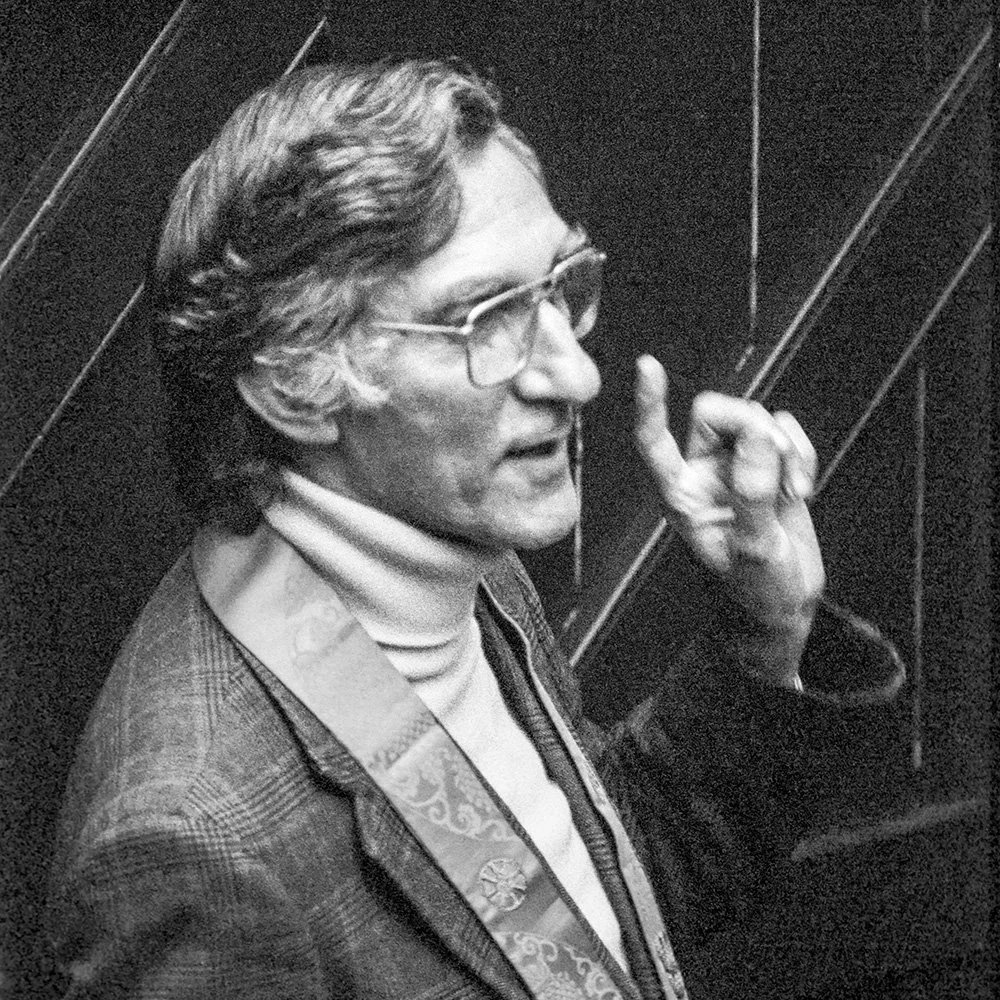
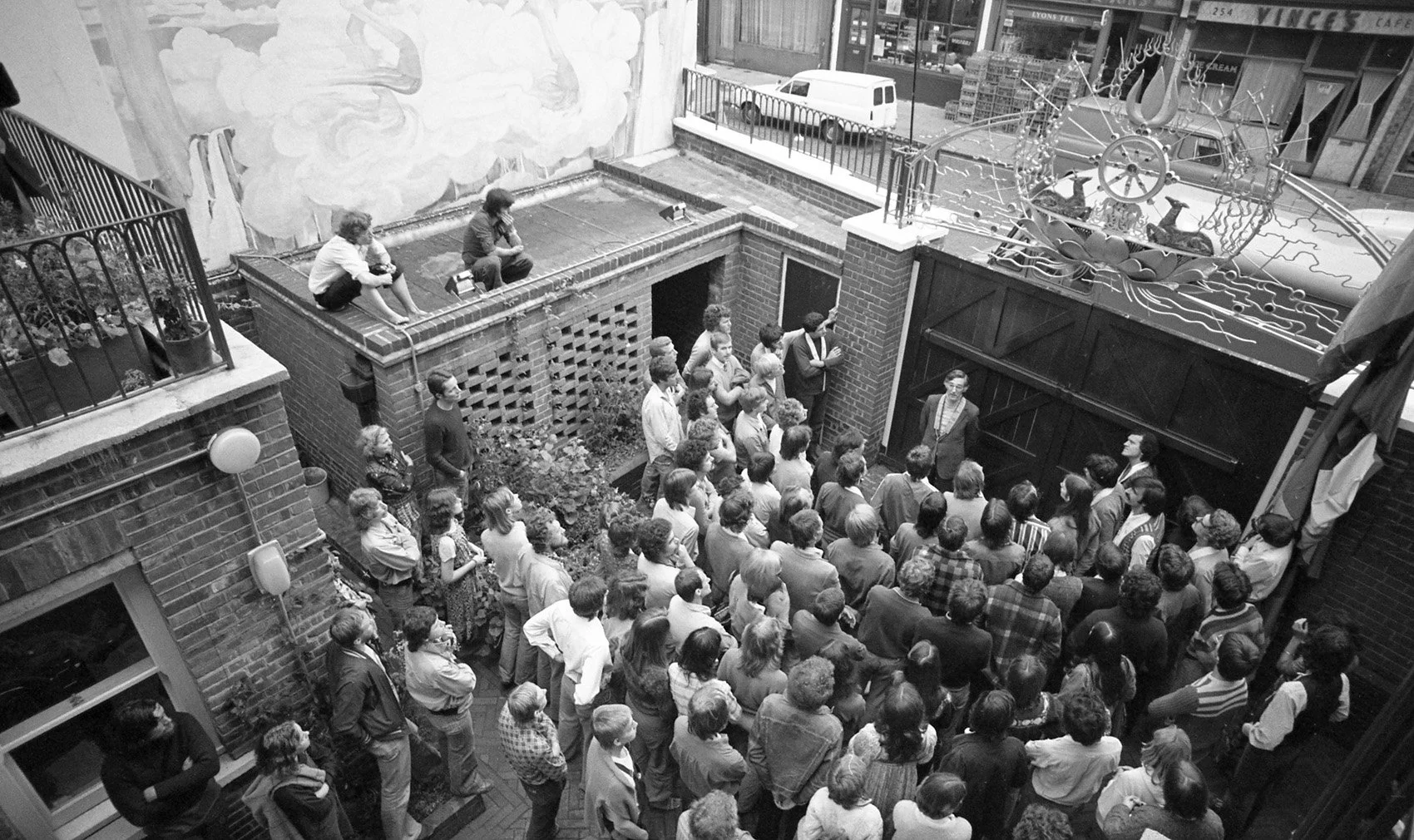
In 1979, at the London Buddhist Centre, on the occasion of the unveiling of the Nalanda Crest that adorns the main entrance, Sangharakshita gave what is perhaps his most important talk on Padmasambhava. Interestingly, there is a certain aura of mystery that surrounds this talk: it is said that Sangharakshita lost his notes and had to give the talk extempore; and that after it was given, he would not allow the recording to be circulated because he had heard that some people had misunderstood it. I don’t know if either of these stories is true, but what is certain is that the talk brought Padmasambhava as a transcendent spiritual principle more vividly into the life of our Order.
He does this not just through exposition about Padmasambhava but through powerful and long readings from The Life and Liberation of Padmasambhava. Here he is reading about Padmasambhava, leaning against a stupa in the cremation ground, turning bright red with inspiration as he turns the wheel of the Dharma for the ḍākinīs —
“There to be seen countless ḍākinīs:
some of them have eyes that dart out sun rays;
others give rise to thunderclaps and ride water buffaloes;
others hold sabres and have eyes which inflict harm;
others wear death’s heads, one above the other, and ride tigers;
others wear corpses and ride lions;
others eat entrails and ride garudas (“great winged birds”);
others have flaming lances and ride jackals;
others, five-faced, are steeped in a lake of blood;
others in the numberless hands
carry many generations of living beings;
others carry in their hands their own heads which they have severed;
(“Well, some of you probably have done that!”)
others carry in their hands their own hearts which they have torn out;
there are others who have made gaping wounds in their own bodies
and who empty out and devour their own intestines and entrails;
there are others who hide and yet reveal their male or female sexual organs,
riding horses, bull, elephants.”

Audio extracts from Sangharakshita’s
Padmasambhava Day 1979 talk

“So, some of the ḍākinīs are primordial forces, so to speak, within ourselves. These are the forces which have to be subdued, which doesn’t mean just crushed, held down by force, but integrated into our conscious attitude so that our conscious attitude, our conscious being, our conscious personality, if you like, can be enriched so that our spiritual life isn’t just some pale anaemic thing, so that it is glowing, as it were, and throbbing with the energy of the ḍākinīs, with the energy of the gods and the demons that have been tamed and transformed….
“This is what Padmasambhava, this is what the Guru, represents. He represents, well, the Dharma itself. He represents Buddhism itself. He represents if you like the Buddha himself, in this particular aspect of subduer of all these primordial energies and forces within us in the depths of our own unconscious mind, so that they can be integrated with the purer clearer energies of the spiritual life, so that our spiritual life, as I’ve said, is not just an anaemic and pale and sort of watery thing but pulsing with life and with energy. We’re not to cut ourselves off from these forces, from these energies, we’re not to disown them, we’re to incorporate them and integrate them which means, so to speak, subduing them.”
Sangharakshita, Padmasambhava Day 1979 (FBA 151)
The Life and Liberation of Padmasambhava
From Sangharakshita’s personal library

In the same talk he also read what might be described as the defining myth of The Life and Liberation of Padmasambhava — the story of the birth and subjugation of the great demon Rudra Tharpa Nagpo or ‘Black Salvation’. It tells the story of a monk who, because of his misunderstanding of a profound teaching, performs many evil actions and eventually takes birth as a terrifying demon who threatens to take over the entire universe. Eventually, he is subjugated by strange incarnations of Padmasambhava and Vajrasattva and becomes the protector, Mahākāla. In another chapter, as Sangharakshita notes, Dharma treasures are found within the body of Tharpa Nagpo — the Unconditioned is found within the Conditioned.
Sangharakshita brings this vision right into our lives. He speaks about the great demons that we are up against, noting that the City of London was only a short distance from the London Buddhist Centre. He was speaking a year after the opening of the London Buddhist Centre and a few months after Lokamitra had started activities of the Order and Movement in India. At this time there was an explosion of Dharma activity not just in Sangharakshita’s life and work, but throughout the Movement, in all kinds of areas. He also had this to say —
“So, we have to go out in various directions, as it were, and this is what we do with our Centres, with our Communities, with our Co-ops. They’re all ways of contacting different aspects of life and transforming them, transfiguring them, because this is essentially what our whole movement is all about. It’s a sort of transforming and transfiguring agency. It’s not simply a Buddhist movement in the narrow sense; it’s not even a spiritual movement in the narrow sense. It’s a stream of spiritual energy, you might say, which transforms, or which deeply transforms and transfigures everything and everyone with whom and with which it comes into contact. So, this is what Padmasambhava did. He encountered a god, transformed it, encountered a demon, transformed it, encountered a ḍākinī, transformed her. So, this is the sort of thing that we must do: allow ourselves to be in contact with these energies, yes, well if we’re strong enough that is, not flee from them, allow ourselves to be in contact with them, especially the deeper energies within our own selves, and transform them, and go forward along the Path with renewed energy, renewed strength and renewed inspiration.”
Sangharakshita, Padmasambhava Day 1979 (FBA 151)