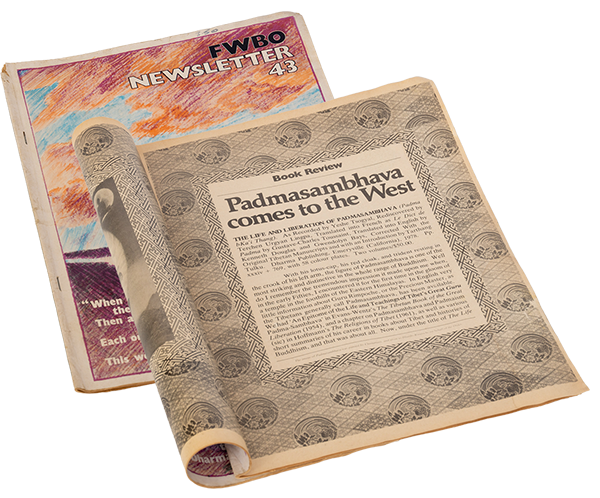
Sangharakshita’s book review of The Life and Liberation of Padmasambhava.
FWBO Newsletter 43 published in the summer of 1979.
Padmasambhava Comes to the West
The Life and Liberation of Padmasambhava (Padma bKa’i Thang). As Recorded by Yeshe Tsogyal. Rediscovered by Terchen Urgyen Lingpa. Translated into French as Le Dict de Padma by Gustave-Charles Toussaint. Translated into English by Kenneth Douglas and Gwendolyn Bays. Corrected with the Original Tibetan Manuscripts and with an Introduction by Tarthang Tulku. Dharma Publishing, Emeryville (California), 1978.
With his lotus cap, his red cloak, and trident resting in the crook of his left arm, the figure of Padmasambhava is one of the most striking and distinctive in the whole range of Buddhism. Well do I remember the tremendous impression it made upon me when, in the early Fifties, I encountered it for the first time in the gloom of a temple in the foothills of the Eastern Himalayas. In English very little information about Guru Rimpoche, or the Precious Master, as the Tibetans generally call Padmasambhava, has been available. We had ‘An Epitome of the Life and Teachings of the great guru Padmasambhava’ in Evans-Wentz’s The Tibetan Book of the Great Liberation (1954), and a chapter on Padmasambhava and Padmaism (sic) in Hoffman’s The Religions of Tibet (1961), as well as various short summaries of his career in books about Tibet and histories of Buddhism, and that was about all. Now under the title The Life and Liberation of Padmasambhava, Tarthang Tulku has brought out in two bulky volumes, an English version of the French translation of the Padma bKa’i Thang, so that at last we are able to follow in detail the career of the extraordinary being who was mainly responsible for introducing Buddhism into Tibet and whose magical personality has dominated the spiritual lives, and fired the imaginations, of a large section of the Tibetan people ever since.
The Padma bKa’i Thang is a terma or ‘treasure’ text which we are told was taken from the heart of the fierce deity guarding the door of the Crystal Rock Cave by Urgyan Lingpa, its preordained revealer, in 1326, after it had lain concealed within the image for more than five centuries. The original authorship of the text is attributed to Yeshe Tsogyal, one of the twenty-five principal disciples of Padmasambhava. The work is divided into 108 Cantos, as the English translator calls them, the first fifty-three of which have been assigned to Part 1 of this edition under the heading ‘India’ and the remaining fifty-five to Part 2 under ‘Tibet’. According to the English translator’s preface, ‘In many respects this work in two volumes is comparable to the Germanic sagas or the Greek and Roman epics’ (p. xx). So far as the Greek and Roman epics are concerned, the comparison is not really valid. Though the story line is reasonably clear and continuous the Padma bKa’i Thang is a somewhat chaotic work and rather lacking in formal literary structure of the more classical type. If it is comparable to anything within the Western epic genre it is, perhaps, rather to the Italian romantic epics and the Arthurian romances. At times, however, particularly in Part 1, the Tibetan work seems to resemble nothing in Western literature so much as Blake’s later ‘Prophetic Books’. There is the same brilliant visual imagery, more Tibetan than Indian (the French translator, Gustave-Charles Toussaint, does not believe that there was a Sanskrit original for the work as claimed), the same visionary atmosphere, and the same ability to project the ‘collective archetypes of the collective unconscious’, both the terrible and the fascinating, in forms of hallucinatory vividness. Prosodically speaking the text consists mainly of long sequences of nine-syllable lines, with both longer and shorter lines also sometimes occurring. Changes of pace and mood are frequent. In the vigorous words of the French translator, ‘Various tones follow each other in the incantation. It passes and repasses from dithyramb to macabre nightmare, from evocatory vertigo to objurgation, from a vehement and sombre realism to didactic dryness, but also to fervour, to the epic, to prophecy’ (p. xxv).
The central event in Padmasambhava’s life is his visit to Tibet, where he performed the celebrated feat of subduing the local gods and demons and participated in the consecration of the great temple-monastery of Samye. This historic visit took place in the reign of King Trisong Detsen (755-797 CE) and modern scholarship therefore regards Padmasambhava’s career as being confined within the limits of the 8th century. The Padma bKa’i Thang takes a different view. While giving a full description of Padmasambhava’s activities in Tibet, it sees the Precious Master’s career as extending forward into the distant future and backward into the remote past and covering a period of altogether nearly three thousand years. The story begins in the land of Uddiyana. Amitabha, the Buddha of Boundless Light, emanates a ray of crimson radiance that falls upon a lotus in the Dhanakosha Lake, whereupon there appears seated in the calyx of the flower an eight year old child. This miraculous child, who is Padmasambhava, is adopted by Indrabhuti, the childless king of Uddiyana, and brought up as heir to the throne. Though married to a beautiful and virtuous princess he is mindful of his spiritual mission and wishing to renounce the kingdom gets himself exiled and, like the Buddha, leaves the palace on horseback. After performing austerities and mastering all manner of arts and sciences he receives ordination as a monk from Ananda, the disciple of the Buddha and his constant companion during the last years of his life. Ananda tells Padmasambhava of the Buddha’s predictions, from which we learn that Padmasambhava was born 42 years after the Parinirvana. Chronology is further dislocated by the fact that, according to Tibetan tradition, the Buddha was born not in 563 BCE (the generally accepted date) but several centuries earlier. Having received ordination Padmasambhava visits Kashmir, Nepal, Zahor, Khotan and other places and stays in the eight great cremation grounds expounding the Dharma to the dakinis. He then goes to China, and learns astrological calculations from Manjushri, the Bodhisattva of Wisdom. In Zahor he meets the spiritually-minded princess Mandarava and accepts her as a disciple, whereupon her father, angry that the princess has consorted with a man, tried to burn him alive. Dakinis extinguish the flames of the pyre, and after seven days it is transformed into a lake of water and Padmasambhava appears in the form of an eight year old boy seated on a lotus and converts the king – an incident that is repeated, with variations, two or three times later in the story. Centuries passing, the Precious Master established the Dharma in Baiddha, Nepal, Serling (Sumatra?), Assam, Tukhara, and Persia, and his career becomes interwoven with the lives of such celebrated personages of Buddhist history as King Asoka – at whose prayer the genies build ten million stupas in a single night – and the teachers Nagarjuna and Aryadeva. There are also reference, apparently anachronistic, to the persecution of Buddhists in Bengal and the destruction fo the great monastery of Vikramasila by the Hulagu Khan of Persia and the shrines of Bodhgaya by the tirthikas or non-Buddhists under King Nagavishnu. Eventually, Padmasambhava receives King Trisong Detsen’s invitation and travels to Tibet via Nepal, subduing the gods and demons as he goes, and forcing them to surrender their life-principle and swear an oath to protect the Dharma.
According to the Padma bKa’i Thang’s reckoning Padmasambhava spent 111 years in Tibet. Samye being completed he and the ‘Bodhisattva Abbot’ Santarakshita perform the consecration ceremony to the accompaniment of many marvels, the king promulgates the code of laws which henceforth governs the social and religious life of Tibet, and the work of translating Buddhist scriptures into the Tibetan language begins. Young Tibetans are trained as translators and, in the case of the most intrepid, go to India to study the Dharma. Indian monk-scholars are invited to Tibet. The most celebrated names in this connection are those of Vairotsana, who studies with twenty-five great Indian pandits, and Vimalamitra, who on his arrival in Tibet shows wonders, the stories of each of them being related at some length over a number of cantos. Trisong Detsen having abolished the sanguinary Bon rites, the work of translation is brought to a successful conclusion, and despite strong opposition from Bonists – due to whose machinations Vairotsana is banished and Vimalamitra slandered – the Dharma is at last established in Tibet. Secular works are also translated. The establishment of the Dharma is followed by the revision of the translations of the scriptures, after which the king recognizes the services of the translators and pandits with lavish gifts and most of them go home. In connection with these latter events, as well as with the death of Princess Pale Lotus, the king’s daughter, Padmasambhava predicts the destruction of the monasteries and the slaughter of the monks and describes how, over a period of five thousand years the teaching of the Buddha will grow and decline until the coming of the next Buddha, Maitreya. He also describes whereabouts in Tibet the termas or ‘treasures’ of texts and other objects which he has hidden for the benefit of future generations will be found, as well as the ‘signs of the earth’ and the times when these treasures will appear and who will discover them. The predictions having been made, King Trisong Detsen dies and Padmasambhava thinks of leaving Tibet but is persuaded to stay for three more years and makes more predictions and gives many teachings. In particular he addresses to the new king and to all the people of Tibet a lengthy exhortation which takes the form of an appallingly realistic description of the sufferings of the six realms of existence and of birth, old age, disease, and death. His mission in Tibet accomplished, the Precious Master mounts a marvellous winged horse, blue in colour, and accompanied by ‘heroes of the four orders’ and enveloped in rainbow-hued light leaves through the heavens for the land of the Rakshasas or cannibal demons – where, enthroned in the Copper-Coloured Mountain, he is still living and teaching.
No bare summary of the Padma bKa’i Thang can possibly do justice to the richness and diversity of its contents. Interwoven with the life of Padmasambhava, which of course is the principal theme, there are biographies of subordinate characters, descriptions of non-human beings, summaries of medical and astrological lore (in the latter the twelve nidanas and the months of the years are correlated with the Twelve Actions of the Buddha!), sublime spiritual teachings, ecstatic songs of praise, a guide book to Samye, catalogues of texts translated, and much else besides. As Tarthang Tulku writes in his Introduction, ‘[The Padma bKa’i Thang] is indeed a treasure, having the complexity and brilliance of a finely cut crystal, its facets the 108 cantos’ (p. xxviii). Not that the crystal is perfectly symmetrical in shape, or that its facets are all equally well cut or of the same degree of brilliance! Nevertheless there is no doubt that, like the rainbow light that plays within the crystal, it is the magical figure of Padmasambhava that dominates the entire work, especially the central group of cantos, and it is the events described in these cantos, i.e. his visit to Tibet and his subjugation of the local gods and demons, that set the tone of the whole extraordinary narrative. In the earlier, Indian part of his three thousand year career Padmasambhava converts dakinis, kings, butchers, black magicians, and tirthikas, while one of the last things he does before leaving Tibet is to make contact with the great demon king Pekar. Reading The Life and Liberation of Padmasambhava one gets the impression not only of a vivid and powerful spiritual ‘personality’ heroically battling with the forces of evil but also of a stream of impersonal spiritual energy which is conterminous with the historical Buddhism itself and which, intervening in the course of events age after age, and assuming a variety of forms, brings under its control all the swirling emotional-psychic energies which at one or another level of mundane existence obstruct the liberating influence of the Dharma. This impression is heightened by the fact that Padmasambhava is actually involved in some of the most important events of Buddhist history, as well as the fact that, at various stages of his career, he is known by different names. He has, we are told, eight secret names, eight borrowed names, eight present names, twenty magic names ‘which vary at will’, and so on. One indeed gets the impression that, perhaps extrapolating from Padmasambhava’s exploits in Tibet, the text sees not only the history of Buddhism but the whole course of mundane existence in terms of a conflict between the forces of light and the forces of darkness – a conflict in which the forces of light are concerned not simply to conquer but to transmute and transform.
The most striking illustration of this almost Gnostic world-view occurs towards the beginning of the Padma bKa’i Thang, in the cantos describing the series of the births of Rudra Tarpa Nagpo, or Black Salvation, and his subjugation by the Horse and the Swine, i.e. by the teacher Tubka Shunukyuwa, himself a form of Padmasambhava, and his disciple Den Pag, in the form of the horse-faced Vajrasattva and the swine-faced Vajrapani. The Rudra is a fallen monk, once a disciple of Tubka, who after myriads of existences in various evil and hideous forms is eventually reborn as a monster with three heads, six hands, four feet, two wings, and nine eyes. Feeding on the corpse of his mother, a prostitute who had been impregnated by three demons, he grows to enormous size and becomes the ruler of the demon kings who have seized control of the earth. Mad with pride, he fancies that there is none greater than he. The Horse and the Swine subjugate him by penetrating him through the rectum and urethra and coming out of the top of his head, where they join each other. Tarpa Nagpo becomes the Dharma protector Mahakala, and is predicted to Buddhahood. He reappears later in the work, towards the end of the canto on ‘The Discourse of the Council of the Treasure, of the Law of the Treasure, of the Revealer of the Treasure’ (Canto 53) where it is said, ‘Although subdued, Rudra Tarpa Nagpo rises up again’, as though he represented, in his unregenerate form, a force which has to be subdued over and over again. In a remarkable passage the termas or ‘treasures’ are described as being hidden in various parts of his cosmic body, as if to suggest that the antidote to egotism is to be found in egotism itself – bodhi in the defilements, the Unconditioned in the conditioned. There is even a suggestion, elsewhere in the work, that the forces of light are actually strengthened by their conflict with the forces of darkness, and that one should, therefore, seek to learn from painful situations rather than run away from them. ‘Hell is the lama of all the Buddhas’ declares the Precious Master, when asked by Prince Lhaje to exert his mercy and cut off the whole misery of the cycle of transmigration for himself and his parents.
Like much Tibetan Buddhist literature, the Padma bKa’i Thang is pervaded by a keen sense of the impermanence of all worldly things and a strong ‘yearning faith’ in the Three Jewels, commitment to which makes it possible for one not only to transcend the human predicament but also to become a stream of ‘impersonal’ spiritual energy working for the emancipation of all living beings. In addition to its vivid portrayal of Padmasambhava himself, and its powerful dramatization of the conflict between the forces of light and the forces of darkness, the work also contains many important spiritual teachings, some of them being of a highly esoteric nature. Partly because they are not always explained in full, partly because of the literary rather than scholarly nature of the French translation, these are often difficult, even impossible to understand. The general import of the work is nonetheless in no doubt whatever. Reading The Life and Liberation of Padmasambhava is a major imaginative and spiritual experience. This is due, principally, to the fact that ‘the poetic beauty and symbolic strength of the Tibetan original’ have been carried over from the French into the English translation, so that we can read this great work of literature in its present version not only for information but also for inspiration. Enjoyment and inspiration are alike enhanced by the reproductions of thankas which illustrate the material within the text, as well as by the care and devotion with which Tarthang Tulku and his co-workers at Dharma Publishing have produced these two splendid volumes. Holding them in our hands, we cannot but agree with Tarthang Tulku that Padmasambhava’s teachings have now come to the West. We cannot but feel that Padmasambhava himself has now come to the West.
Urgyen Sangharakshita